Small posture changes, outsized results
Five sub-two-minute shifts — reviewed by our clinical team — that quietly rewire how your spine handles every hour of your day.
Most posture advice fails for the same reason most diets fail: it asks you to override a default. "Sit up straight" is a rule your body will forget the moment your attention drifts back to your screen. What actually works is smaller — a handful of micro-changes you repeat until they become the new default. None of the five below takes more than two minutes. Together, reviewed by our clinical team, they quietly rewire how your spine handles every hour of your day.
1. Raise your screen until your eyes hit the top third
The average adult head weighs about 10–12 lb (4.5–5.5 kg) in a neutral position. Every inch it drifts forward roughly doubles the effective load on the small muscles at the base of your skull. That's why "text neck" isn't a metaphor — it's leverage.
The fix: Stack books, use a laptop stand, or mount your monitor so the top third of the screen sits at eye level when you're sitting tall. Your chin naturally settles back. Your upper traps stop white-knuckling your skull all day.
If you use a laptop as your primary device, add an external keyboard and mouse. A laptop is either a good screen or a good keyboard — never both at the same time.
2. Stack your ribs over your hips
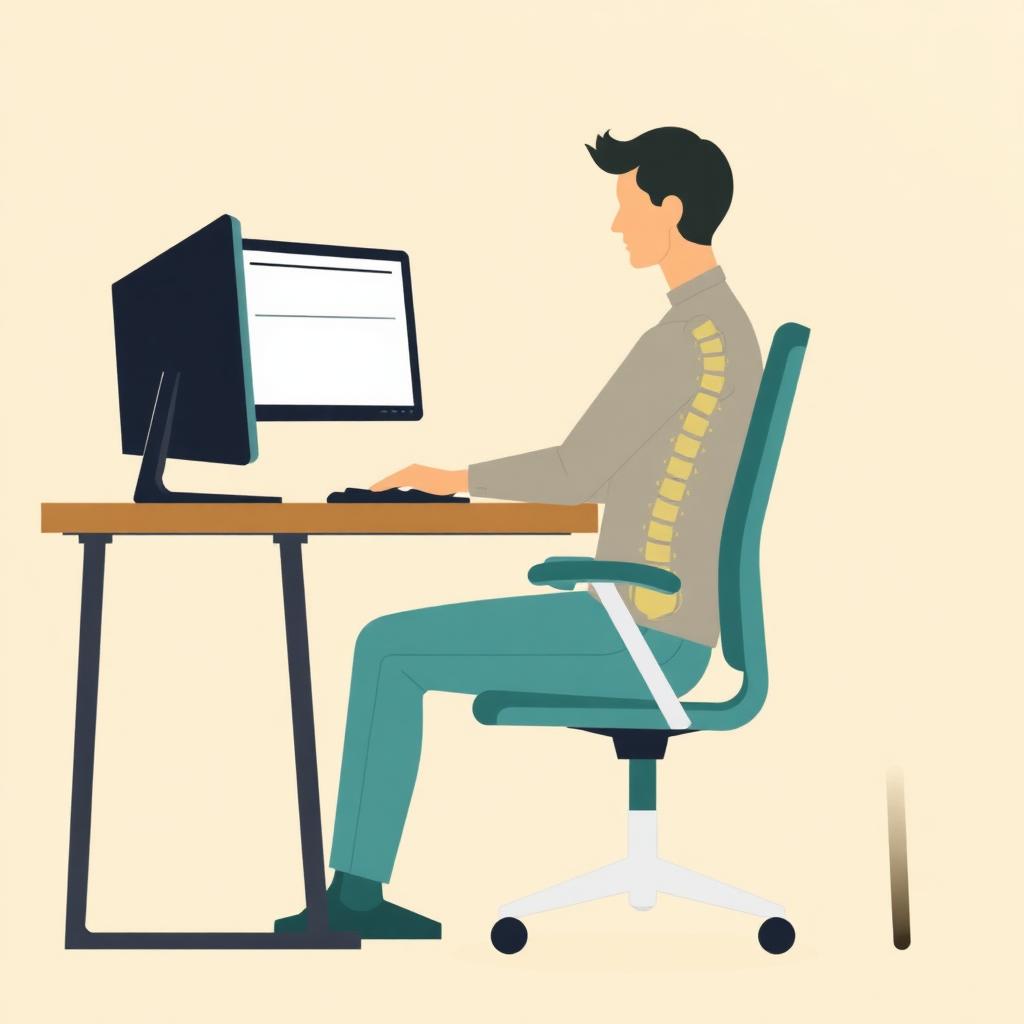
Slouching isn't really about your shoulders. It starts one floor down, in the pelvis. When the pelvis tips forward or slides forward on the chair, the ribcage collapses to compensate, and the shoulders round to catch up.
The fix: Slide your hips fully to the back of your chair. Inhale and lift your ribcage straight up — imagine stacking blocks: pelvis, ribcage, head. Exhale and let your shoulders drop back and down. Hold the feeling for three breaths. Do this once every 45 minutes. Two weeks in, this becomes what sitting feels like.
3. The 20-20-20 reset, with a twist
Optometrists popularized the 20-20-20 rule for eye strain: every 20 minutes, look at something 20 feet away for 20 seconds. Borrow it for your spine.
The fix: When your 20-minute reminder fires, stand up, take five slow breaths, and do one gentle backbend — hands on your low back, elbows in, look up at the ceiling for a slow count of five. This resets the thoracic extension that hours of sitting compress out of you. It takes 25 seconds. Set a phone timer if you have to.
4. Walk with your phone pocketed, not raised
Walking is one of the few times most people naturally decompress the spine — until they lift a phone in front of their face and reintroduce a 30-degree neck flexion the whole time.
The fix: For any walk under 10 minutes, keep the phone pocketed. Look up. If you're on a call, use earbuds. If you have to read something, stop, read it, then keep walking. Your neck gets those minutes back.
5. Sleep with your spine in neutral
You spend a third of your life in bed. The wrong pillow height quietly undoes a lot of what the other four habits build.
The fix, by sleep position:
- Side sleeper: pillow thick enough that your head is level with your spine — not tilted up or down. Add a pillow between the knees.
- Back sleeper: thinner pillow; a small roll or rolled towel under the knees offloads the low back.
- Stomach sleeper: try to transition away. If you can't, use the thinnest pillow you own (or none) and put a pillow under the pelvis to reduce lumbar hyperextension.
Why "small" beats "strict"
Posture programs that try to hold you in a rigid position all day fail because the human spine isn't meant to be static — it's meant to move. The goal isn't a single perfect posture. It's a wider range of comfortable positions, revisited often. The five habits above don't lock you in; they just keep pulling your default back toward neutral before compensations turn into pain.
When posture isn't the whole story
If pain persists despite consistent habit changes for 3–4 weeks, the posture is often a symptom, not the cause. Common culprits:
- Weak deep core / glute medius that can't hold the pelvis stable
- Restricted thoracic rotation from prior injury or scarring
- A stiff hip or ankle forcing the low back to over-move
- Sleep quality or stress driving muscle guarding
A licensed chiropractor can evaluate which link in the chain is doing the work no one else will — and give you a targeted plan instead of another generic stretching list.
The two-week experiment
Pick two of the five above. Do them consistently for 14 days. Then add a third. That's it. You don't need a standing desk, a lumbar cushion, or a $700 chair. You need small changes your body will actually keep.
Educational information reviewed by operators of The Joint Chiropractic Rosemead — not medical advice. Always consult a licensed clinician for your specific situation.
Ready to feel better? Book a $29 intro visit.
$29 New Patient Special — exam, consult & first adjustment. No appointments needed. No insurance required. Open evenings & weekends.